 Reviews


 Proudly American


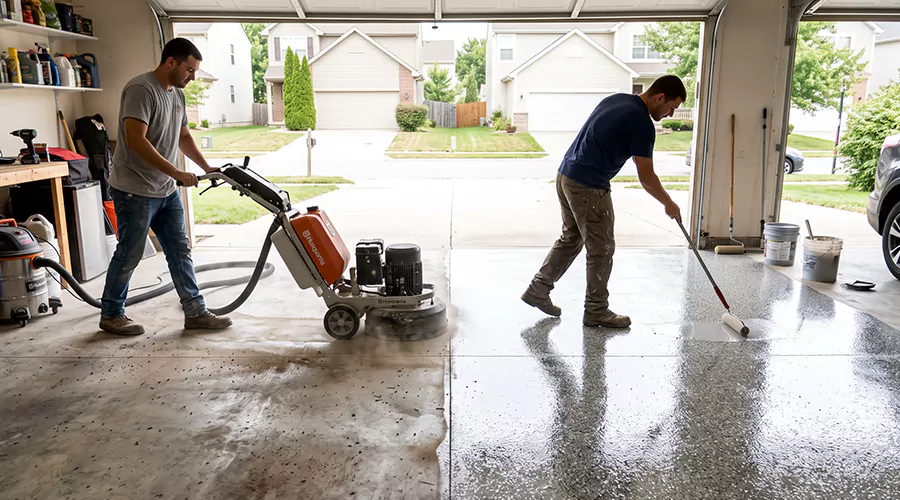
Concrete floor refinishing is the process of repairing and renewing an existing concrete surface without removing and replacing the entire slab. The work can include grinding or polishing followed by a protective coating. Mold remediation may also be needed when moisture has caused mold growth on or around the concrete floor. In 2026, many professional projects cost roughly $3 to $12 per square foot depending on the finish and repair needs.
Refinishing works best when the concrete remains structurally stable. Large moving cracks or major settlement need correction before cosmetic surface work begins.
What Does Concrete Floor Refinishing Include?
Concrete floor refinishing removes worn surface material and prepares the slab for a renewed finish. The exact process depends on whether the floor is stained or scratched. Existing coatings may also need removal before another treatment can bond correctly.
Common work can include:
- Deep surface cleaning
- Old coating removal
- Grinding rough areas
- Repairing stable cracks
- Filling small surface defects
- Polishing exposed concrete
- Applying stain when desired
- Adding a compatible protective coating
Concrete restoration may require more repair work when the damage extends below the surface.
When Does a Concrete Floor Need Refinishing?
A concrete floor usually needs refinishing when normal cleaning no longer improves its appearance or the protective surface has started wearing away. Light cosmetic wear is a better candidate than major slab movement.
Watch for these signs:
- The surface has become noticeably dull.
- Old coating is peeling.
- Fine scratches cover traffic areas.
- Concrete produces excessive surface dust.
- Stains remain after proper cleaning.
- Small stable cracks are visible.
- Previous patches stand out.
- The finish has worn through in busy areas.
- Minor surface pitting has developed.
- The floor has become harder to keep clean.
A worn finish does not mean the slab itself has failed.
How is a Concrete Floor Refinished?
The process normally starts with inspection because coatings cannot correct structural movement. The surface is then prepared until it is clean and suitable for the selected finish.
A typical process follows these steps:
- Inspect the slab for active cracks.
- Check for moisture problems.
- Remove old coatings when necessary.
- Grind or prepare the concrete.
- Repair stable surface defects.
- Remove all preparation dust.
- Apply the chosen finish.
- Allow the surface to cure before use.
Proper preparation matters because a new finish is only as secure as the concrete beneath it.
Is Refinishing the Same as Resurfacing?
Refinishing and resurfacing overlap, but they are not always the same. Refinishing can involve polishing or renewing a coating. Resurfacing generally adds a new cement-based layer over an existing slab.
| Process | Best Used For |
|---|---|
| Polishing | Dull but stable concrete |
| Coating renewal | Worn protective finish |
| Light grinding | Scratches or surface irregularities |
| Resurfacing | Wider surface deterioration |
| Crack repair | Stable localized defects |
| Replacement | Major structural failure |
The correct method should match the depth of the damage.
Can Cracked Concrete Floors Be Refinished?
Stable hairline cracks can often be repaired before the floor is refinished. A crack that keeps widening needs closer evaluation because a surface coating cannot stop movement below the slab.
Check whether both sides of the crack remain level. Vertical displacement is a stronger sign of structural movement than a thin level crack.
Refinishing over an active crack can make the new surface look good temporarily while the crack continues through the coating.
Can Uneven Concrete Floors Be Refinished?
Minor surface unevenness can often be corrected through grinding or a compatible leveling system. Larger height differences may indicate settlement.
A straightedge can help distinguish a shallow low spot from deeper slab movement.
Place a long straightedge across the affected area and measure the largest gap below it. Then inspect nearby cracks for height differences. A stable shallow dip is a much better refinishing candidate than a sunken slab section.
What Finish Can Be Used on Concrete Floors?
The finish depends on how the floor is used and the appearance you want. Indoor residential floors may be polished while garages often use protective coating systems.
Common options include:
- Polished concrete
- Concrete stain
- Clear sealer
- Epoxy-type coatings
- Other floor-rated coating systems
Surface preparation requirements differ between products. A coating designed for one environment may not perform well in another.
How Much Does Concrete Floor Refinishing Cost?
In 2026, basic professional work often falls around $3 to $12 per square foot. Extensive repairs or decorative treatments can raise the price.
| Work Needed | Typical Cost Effect |
|---|---|
| Cleaning and light preparation | Lower |
| Basic polishing | Moderate |
| Grinding old coatings | Moderate to higher |
| Crack repair | Higher |
| Decorative finish | Higher |
| Moisture correction | Higher |
For a 500-square-foot floor, a $3 to $12 planning range equals about $1,500 to $6,000 before major structural repairs.
How Long Does Refinishing Take?
A small straightforward floor may take two to three days. Larger projects can require three to seven days when grinding or multiple coating stages are involved.
Cure time may continue after application. Heavy furniture or vehicle traffic may need to stay off the floor longer than light foot traffic.
Always follow the specific finish manufacturer's cure schedule.
What Can You Check Yourself?
A simple surface and crack inspection can show whether refinishing is likely to address the problem.
Use this check:
- Clean a small section thoroughly.
- Check whether dullness remains.
- Measure visible cracks.
- Look for vertical displacement.
- Check whether coating is peeling.
- Note persistent damp areas.
- Photograph questionable sections.
Do not coat over unexplained moisture. Trapped moisture can contribute to peeling later.
When Should You Call a Professional?
Professional assessment is appropriate when cracks show movement or a large area of coating has failed. Moisture coming through the slab also needs investigation before another finish is installed.
Consider professional help when:
- Cracks have vertical displacement.
- Several sections have settled.
- Moisture repeatedly reaches the surface.
- Old coatings are difficult to remove.
- Previous refinishing has failed.
- Large areas are badly pitted.
- Structural concrete may be involved.
How Can You Protect a Refinished Concrete Floor?
Routine maintenance reduces abrasion and extends the life of the new surface.
Use these habits:
- Sweep abrasive grit regularly.
- Clean spills promptly.
- Use cleaners compatible with the finish.
- Place protective pads beneath heavy furniture.
- Address new cracks early.
- Reapply protective treatments when required.
Conclusion
Concrete floor refinishing renews a worn slab without automatically replacing the concrete below it. Grinding or polishing can correct many surface problems when the slab remains stable. Active cracks and moisture problems should be addressed before a new finish is applied. A simple crack and moisture inspection can reveal whether the problem is mainly cosmetic. If the slab is moving, professional evaluation should come before refinishing.
Frequently Asked Questions
Can old concrete floors be refinished?
Yes. Age alone is not a problem when the slab remains structurally stable.
Can peeling concrete coatings be refinished?
Yes, but loose coating must be removed and the cause of failure should be corrected first.
Can concrete be refinished without grinding?
Sometimes. The preparation method depends on the existing finish and condition of the slab.
How long does refinishing take?
Many projects take about two to seven days including preparation and initial curing.
Can stained concrete be refinished?
Yes. Existing stain condition should be evaluated before another color or coating is applied.
Is refinishing cheaper than replacing concrete?
Usually, when the existing slab is stable and the problem affects mainly the surface.